

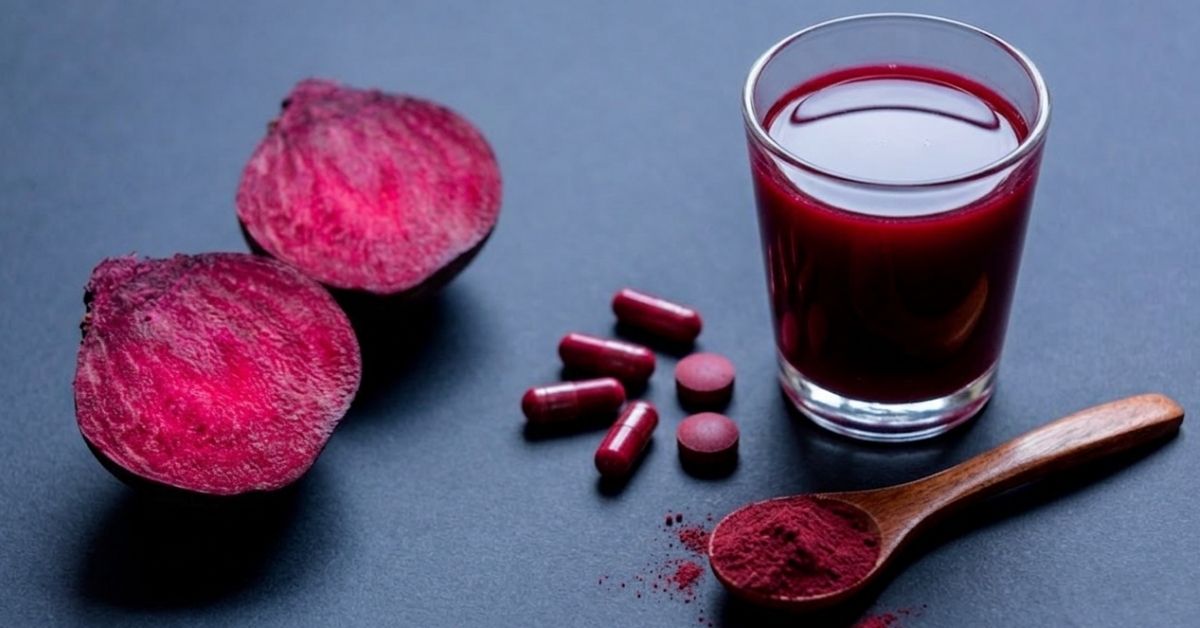
Beetroot has been enjoying a well-deserved comeback as a superfood for several years now. However, those who want to integrate beetroot into their daily lives will encounter various forms of administration, which differ significantly in quality, processing, and benefits, from fresh tubers to powders, capsules, and juice.
In this article, you will learn what makes beetroot so interesting, where many beetroot preparations reach their limits, and which aspects are truly crucial for selection.
Table of Contents
The most important things in brief
Beetroot offers a unique combination of nitrate, betanin, betaine and polyphenols
Despite these valuable ingredients, it is rarely consumed regularly due to taste, preparation effort, and oxalic acid.
Forms of administration differ greatly in nutrient density and everyday practicality
Beetroot juice concentrates offer a particularly compact and everyday-friendly form of intake
Why beetroot is so valuable for your body
Beetroot is one of the foods that has received a lot of attention in research for years. Its natural nitrate content is at the forefront. In the body, nitrate is converted into nitric oxide, a messenger substance associated with the regulation of blood circulation and blood pressure (1).
Beetroot has also long been established in the sports context: studies show correlations between a nitrate-rich diet and effects on endurance and oxygen efficiency (2).
Beetroot also contains other valuable nutrients:
- Betanin: The red pigment, which is attributed antioxidant properties
- Betaine: A compound associated with normal homocysteine metabolism
- Polyphenols: Secondary plant compounds that can contribute to the reduction of oxidative stress
- Minerals: Iron, calcium, zinc, manganese, and more for various bodily functions (3)
If you would like to learn more about the health effects of beetroot, click here.

Nevertheless, beetroot is rarely consumed regularly
Despite its interesting ingredients, beetroot is relatively rarely consumed regularly in everyday life. There are several reasons for this.
- The taste: The earthy, slightly sweet-tart taste of beetroot is an acquired taste for many. The preparation is also not always considered straightforward, especially due to its strong coloring.
- Oxalic acid: Raw beetroot contains relatively high levels of oxalic acid. It is a natural component of beetroot and can play a role in the formation of kidney stones in people with a predisposition, especially with larger amounts of raw tubers (4).
Against this background, the question arises of how beetroot can be meaningfully integrated into everyday life. There are now numerous forms of administration such as beetroot powder, capsules, or juice, which are intended to make the benefits of beetroot accessible in a concentrated and everyday-friendly form.
However, these products differ significantly in processing, composition, and dosage. If you want to benefit from the potential advantages of beetroot, a differentiated approach is therefore sensible.
Our recommendation
Beetroot powder
At first glance, beetroot in powder form seems like a practical solution: it has a long shelf life, is versatile, and can be easily stirred into smoothies, yogurt, or water. However, a closer look reveals some limitations.
What you should pay attention to:
- Drying ratio: Approximately 5 kg of fresh beetroot yields about 1 kg of powder. A typical serving (3–5 g) corresponds to only about 15–25 g of fresh tuber.
- Typical consumption amounts: The amounts used in everyday life are usually significantly lower than the dosages studied. To make a meaningful contribution at all, such products are often combined or enriched with additional nutrients.
- Processing influences: Heat-sensitive compounds, such as polyphenols, can be partially lost during drying. Therefore, beetroot powder does not always fully represent the fresh tuber (5).
Beetroot powder can still be a useful supplement, for example, to enrich dishes in terms of taste and appearance. However, when it comes to targeted intake of larger amounts of specific ingredients, this form of administration often reaches its limits in everyday life.

Beetroot capsules and tablets
Beetroot capsules and tablets are considered the most convenient form of administration: no taste, no discoloration, and easy to take with water. Especially for on-the-go, they seem ideal at first glance. However, a closer look reveals some limitations here as well.
What you should pay attention to:
- Basis of the products: Many capsules simply contain concentrated dried beetroot powder. The fundamental issue of quantity therefore remains.
- Typical dosages: The amounts contained per beetroot capsule are usually very small and often below the amounts studied.
- Processing and concentration: Certain ingredients such as nitrate cannot be concentrated arbitrarily without changing the natural composition.
Beetroot capsules and tablets can be a practical option in everyday life. However, when it comes to targeted intake of relevant amounts of certain ingredients, it is worth looking more closely at the respective composition and dosage.

Beetroot Juice
A look at the scientific literature shows that a large proportion of studies on beetroot have been conducted with juice. There's a simple reason for this: beetroot juice delivers the ingredients in a form that is well-standardized and can be consumed in larger quantities.
Beetroot juice contains a wide spectrum of natural compounds, including nitrate, betanin, betaine, polyphenols, as well as vitamins and minerals. Unlike isolated products, it largely reflects the natural composition of fresh beetroot (4).
However, in everyday life, classic beetroot juice presents some practical challenges: limited shelf life, storage effort, and comparatively large quantities per serving.

Beetroot Juice Concentrate as the Optimal Solution
A possible alternative is beetroot juice concentrate: a large portion of the water is gently removed from the juice. This results in a significantly smaller volume with a high concentration of the contained nutrients, which facilitates both storage and everyday use.
What to look out for:
- High nutrient density: Due to water removal, the nutrient density per serving increases while the volume decreases. The contained ingredients are therefore available in a significantly more compact form.
- Natural active ingredient complex: Important components such as nitrate, betaine, and polyphenols are largely preserved during the gentle concentration process, so that the natural matrix of the beetroot is well represented.
- Everyday usability: Even small amounts are sufficient and can be flexibly stirred into water, juice, or smoothies.
- Processing (e.g., fermentation): Depending on the manufacturing process, the composition can change. In fermented varieties, for example, some of the oxalic acid is broken down, which positively influences taste, tolerability, and safety (7).
Our Recommendation
Betanio PLUS is a high-quality organic beetroot juice concentrate that delivers the valuable ingredients of beetroot in concentrated form, with 46 times less oxalic acid and a mild, balanced taste.
Overview: Comparison of Beetroot Forms
| Criterion | Fresh Beetroot | Powder | Capsules & Tablets | Juice | Juice Concentrate |
|---|---|---|---|---|---|
| Nutrient Density per Serving | low to moderate | moderate | low to moderate | moderate | high (concentrated) |
| Proximity to Natural Root | 100% | limited (processing) | limited (extracted form) | high (complete juice) | high (concentrated juice matrix) |
| Typical Serving Size | variable, often small | small (3-5 g) | very small per capsule | relatively high (by the glass) | small volume, high depth of effect |
| Processing Influence | none | drying possible with losses | strong (extraction/encapsulation) | low | moderate (depending on process) |
| Taste / Acceptance | limited | easily hidden | neutral | earthy, intense | easily incorporated |
| Special Features | unprocessed natural product | flexible to use | maximum convenience | most scientifically studied | combination of practicality + concentration |
Conclusion
Beetroot is one of the most fascinating vegetables of our time, not least because of its nitrate content and bioactive ingredients such as betanin, betaine, and polyphenols. Those who want to benefit from this special nutrient matrix should consciously choose the form of administration. While powders and capsules are practical for everyday use, they often do not reach the quantities considered in scientific studies.
A particularly well-thought-out solution is beetroot juice concentrate such as Betanio PLUS. It is gently processed and fermented. It therefore combines high nutrient density with easy application, good shelf life, and offers a reduced oxalic acid content with a mild taste.
What effect does beetroot juice have on the body?
Beetroot juice naturally contains nitrate, which is converted into nitric oxide in the body. This messenger substance is associated with the regulation of blood pressure and circulation, as well as with effects on endurance performance. Beetroot also contains other nutrients that can have a positive impact on health.
Is beetroot powder as effective as fresh beetroot?
Beetroot powder is concentrated, but usually delivers smaller amounts per serving than fresh root or juice. Additionally, heat-sensitive ingredients can be partially reduced by drying.
What are the advantages of beetroot capsules?
Beetroot capsules primarily offer convenience: no taste, easy dosage, and good everyday usability. However, the amounts of beetroot extract contained are often relatively small.
How often should one consume beetroot?
Study-based effects are usually observed with regular, daily, or multi-week intake. The crucial factor is less the form than the continuous and sufficient supply of certain ingredients.
What is the difference between beetroot juice and juice concentrate?
Juice concentrate is produced by gently removing water from beetroot juice. This results in a higher nutrient density with a smaller volume and better everyday usability.
How can beetroot best be integrated into daily life?
In addition to the fresh root, juice, powder, capsules, or concentrates are often used. For regular use, liquid or concentrated forms are often more practical and easier to dose.
What does fermented beetroot do?
Fermentation can improve digestibility and reduce oxalic acid content. Additionally, nutrients can become more bioavailable and shelf life is extended.
References for further reading
- Bondonno CP, Pokharel P, Erichsen DW, Zhong L, Schullehner J, Kyrø C et al. Source-specific nitrate intake and incident dementia in the Danish Diet, Cancer and Health Study. Alzheimers Dement 2025; 21(12):e70995.
- Esen O, Dobbin N, Callaghan MJ. The Effect of Dietary Nitrate on the Contractile Properties of Human Skeletal Muscle: A Systematic Review and Meta-Analysis. J Am Nutr Assoc 2023; 42(4):327–38.
- Chhikara N, Kushwaha K, Sharma P, Gat Y, Panghal A. Bioactive compounds of beetroot and utilization in food processing industry: A critical review. Food chemistry 2019; 272:192–200. Available at: https://pubmed.ncbi.nlm.nih.gov/30309532/.
- Soliman NR, Effat BAM, Mehanna NS, Tawfik NF, Ibrahim MK. Activity of probiotics from food origin for oxalate degradation. Arch Microbiol 2021; 203(8):5017–28.
- Brzezińska J, Szewczyk A, Brzezicha J, Prokopowicz M, Grembecka M. Evaluation of Physicochemical Properties of Beetroot-Based Dietary Supplements. Foods 2021; 10(8). Available at: https://pubmed.ncbi.nlm.nih.gov/34441471/.
- Flueck JL, Bogdanova A, Mettler S, Perret C. Is beetroot juice more effective than sodium nitrate? The effects of equimolar nitrate dosages of nitrate-rich beetroot juice and sodium nitrate on oxygen consumption during exercise. Applied physiology, nutrition, and metabolism = Physiologie appliquee, nutrition et metabolisme 2016; 41(4):421–9. Available at: https://pubmed.ncbi.nlm.nih.gov/26988767/.
- Mogna L, Pane M, Nicola S, Raiteri E. Screening of different probiotic strains for their in vitro ability to metabolise oxalates: any prospective use in humans? J Clin Gastroenterol 2014; 48 Suppl 1:S91-5. doi: 10.1097/MCG.0000000000000228
'%20fill='%235dd95d'%3E%3Cpath%20d='M%209.249787330627441%2017.17169380187988%20L%204.762476921081543%2012.68437480926514%20L%207.214956283569336%2010.23189544677734%20L%209.015677452087402%2012.03262424468994%20L%209.369227409362793%2012.38618469238281%20L%209.722777366638184%2012.03262424468994%20L%2016.32264709472656%205.432744979858398%20L%2018.65010833740234%207.760213375091553%20L%209.249787330627441%2017.17169380187988%20Z'%20stroke='none'/%3E%3Cpath%20d='M%209.249578475952148%2016.46436309814453%20L%2017.94319725036621%207.760422229766846%20L%2016.32264709472656%206.139865875244141%20L%2010.07633686065674%2012.38618469238281%20L%209.369227409362793%2013.09329414367676%20L%208.662117004394531%2012.38618469238281%20L%207.214955806732178%2010.93901634216309%20L%205.469596385955811%2012.68437480926514%20L%209.249578475952148%2016.46436309814453%20M%209.249997138977051%2017.87900352478027%20L%204.05537748336792%2012.68437385559082%20L%207.214957237243652%209.524794578552246%20L%209.369227409362793%2011.67907428741455%20L%2016.32264709472656%204.725644111633301%20L%2019.35699653625488%207.76000452041626%20L%209.249997138977051%2017.87900352478027%20Z'%20stroke='none'%20fill='%23fff'/%3E%3C/g%3E%3C/svg%3E%0A "Show in Citavi") .
.
📖 Mehr im Cellavent Rote-Bete-Ratgeber
Wir haben einen umfassenden Ratgeber zu diesem Thema erstellt – mit wissenschaftlichem Hintergrund, EU-Health-Claim-Status, Vergleichstabelle aller Cellavent-Varianten und FAQ.

Leave a comment
This site is protected by hCaptcha and the hCaptcha Privacy Policy and Terms of Service apply.